The “AI is failing” headline has become predictable. Executives cite disappointing pilots. Boards question budgets. Teams quietly shelve tools that never made it to production. Yet beneath these stories lies a simpler problem: most organisations never defined what success looks like before they started.
AI projects fail to deliver ROI, not because the technology is inadequate but because measurement, ownership, and integration remain afterthoughts. This article provides a practical path forward—one that defines ROI before the pilot begins, picks the right workflows, and builds the controls that turn experimental effort into measurable business value.
The “AI is Failing” Story is Mostly a Measurement Problem
AI failure headlines often blur the line between technology and business integration. While language models perform well in benchmarks, they may hallucinate, show bias, or struggle with proprietary workflows—especially in regulated fields like pharmacovigilance. The real issue is whether organisations have done the work required to capture value.
When we say an AI project “failed,” we usually mean the pilot never reached production, the tool reached production, but nobody adopted it, or adoption occurred, but nobody measured the outcome. None of these is a technology failure. They are planning failures.
The path forward requires treating ROI as a design requirement—not a retrospective hope. Organisations that define metrics, set baselines, and name accountable owners before deployment move from pilot theatre to production value.
What the “95%” Claim Actually Says—and What It Doesn’t
Project NANDA at MIT Media Lab’s State of AI in Business 2025 report presented a headline statistic: 95% of task-specific generative AI implementations fail to achieve marked and sustained measurable P&L impact, based on 52 structured interviews and 153 survey responses—a sample size and methodology that independent researchers have questioned regarding statistical validity and generalizability.
This finding describes a ‘GenAI Divide’ separating successful implementers from stalled experiments; however, the research methodology relies on self-reported interview data rather than independently verified company records, and multiple analysts have called for full methodological disclosure, noting that enterprise IT projects historically experience comparable or higher failure rates.
What this means: the vast majority of pilots produce no measurable financial return. The biggest problem was not the model’s capability. The research team identified a ‘learning gap’ as one contributing factor; however, the full scope of failure causes includes data quality issues, poor process definition, inadequate change management, cost underestimation, and adoption resistance—suggesting the gap reflects broader organisational capability limitations rather than knowledge deficit alone.
Additionally, in regulated environments such as the pharmaceutical industry, organisations must navigate compliance requirements that generic enterprise AI frameworks do not address, creating a learning gap specific to GxP-regulated AI implementation.
What this does not mean: AI never works, or the technology is fundamentally flawed. GenAI doesn’t fail in the lab. It fails in the enterprise when it collides with vague goals, poor data, and organisational inertia—though it is worth noting that enterprise IT projects broadly experience 80-90% failure rates, suggesting AI pilot performance may not be uniquely problematic when contextualised against historical digital transformation outcomes.
Pilot Success vs Production Success: A demo proves capability. Production proves value. The gap requires integration, adoption, and measurement—none of which happen automatically.
The Real Misconception: ROI Isn’t a Feeling—It’s a Design Requirement
Organisations struggle to find AI ROI because they never designed for it. Common traps include defining ROI after the pilot concludes, claiming benefits as “potential” rather than measured, operating without a baseline, and watching value disappear through non-adoption.
Productivity benefits can lag while organisations retool processes and retrain staff. This makes early ROI difficult to capture—unless measurement was built into the project from the start.
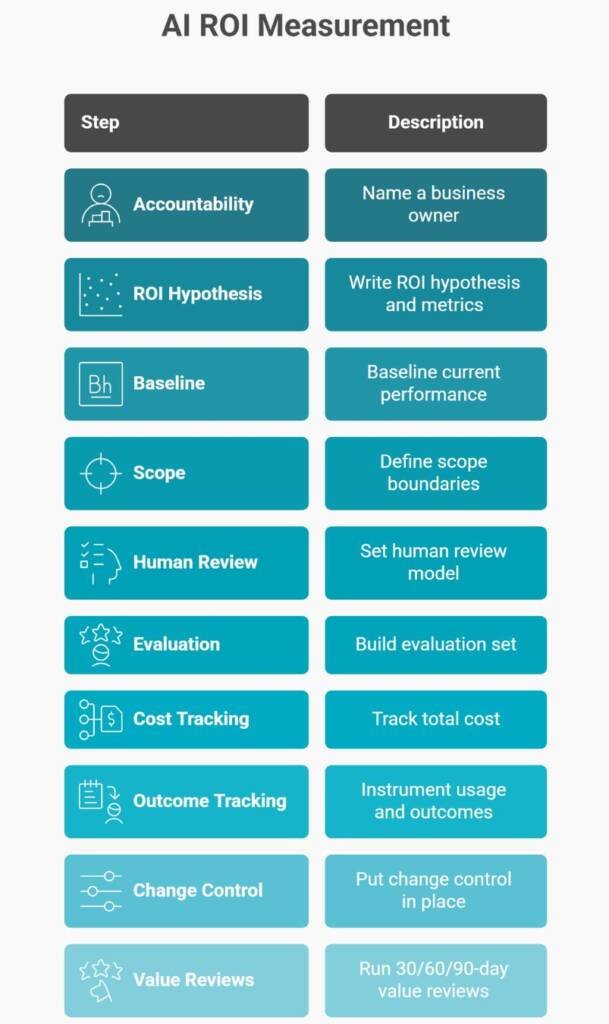
ROI requires three things before deployment: a hypothesis stating the expected outcome, a baseline capturing current performance, and decision rules defining what happens at review.
Where Do You Start? A Low-Risk Pathway to Prove ROI
Moving from experimental to production requires a structured approach.
Step 1: Pick a Workflow, Not a Technology
Focus on work, not technology. Select a repeatable, measurable workflow that meets regulatory needs. In pharma, start with adverse event narratives, submission docs, quality reports, or signal detection—each needing upfront validation, data integrity, and change control built in from the outset.
Avoid high-stakes processes for initial pilots. The goal is to prove the method—define, measure, deploy, review—before applying it to complex work.
Step 2: Write an ROI Hypothesis
Before deployment, write a clear hypothesis: “If we apply X to Y, we expect a Z change in metric within N weeks.”
Define one primary metric plus two guardrail metrics (quality, risk, or cost indicators that should not deteriorate).
Step 3: Create the Baseline
Measure current performance before deployment. Baseline metrics typically include cycle time, rework percentage, escalation rate, and throughput. Without a baseline, you cannot demonstrate improvement.
Step 4: Set Decision Rules
Define what triggers scale, iteration, or stop. Name the business owner who makes the call. This person should sit in operations, not IT.
How AI is Used in Business Workflows—and What to Control
Each AI use case requires specific controls and documentation. The following table maps common applications to their
governance requirements:
| Use case | AI application examples | Governance requirements |
|---|
Adverse Event Processing | Narrative ingestion, coding, signal detection | ALCOA+ data integrity, audit trail immutability, full traceability of all AI actions, validated source capture, human review checkpoints |
Regulatory Submission Support | CTD generation, synopsis drafting, IMPD support | Change control on templates, quality review approval, validation of references, role-based access controls, documented sign-off workflow |
Safety Monitoring & Signal Detection | Real-time adverse event pattern recognition, trend monitoring | Quantified performance metrics, false positive monitoring, bias testing, HITL escalation rules, ongoing model monitoring with periodic re-validation |
Quality Investigation Reports | Root cause analysis drafting, trending analysis | Human investigator sign-off, editable AI-suggested content, controlled prompts, source traceability, audit trail of edits and approvals |
Drafting | Emails, policies, proposals | Templates, approval rules, prompt versioning |
Compliance Checks | Automated document compliance reviews, deviation detection | Defined rulesets, human compliance review for exceptions, validated checklists, version-controlled requirements library, audit-ready evidence capture |
Training & Enablement | Onboarding material creation, SOP summarisation | Content review and approval, controlled knowledge sources, avoidance of hallucinations via grounded retrieval, periodic refresh and re-approval |
Analytics & Reporting | KPI dashboards, trend summaries, executive reporting | Validated calculations, consistent definitions, human review of insights, governance of data sources, controlled access and audit trails |
Knowledge Management | Searchable SOP/QMS retrieval, FAQ copilots | Controlled document sources, permissioning, citation requirements, content lifecycle management, periodic validation of knowledge accuracy |
Every “how it’s used” decision implies a control requirement. Organisations that deploy without documenting these controls create risks they cannot quantify and values they cannot prove.