
No AI exemption exists under privacy law. The “reasonably necessary” standard under APP 3 creates a high bar when organisations collect extensive datasets for AI training without specific, defined purposes. AI outputs can themselves constitute personal information—making organisations responsible for synthetic data generated through inference.
What Changed Recently—Why 2025-2026 Is a Turning Point
The Privacy and Other Legislation Amendment Act 2024 fundamentally reshaped the risk calculus for AI deployments. Three reforms demand immediate attention.
First, the statutory tort for serious invasion of privacy, effective June 2025, creates direct civil liability. Individuals can now sue for privacy breaches without demonstrating financial harm. The Federal Court’s October 2025 decision in OAIC v Australian Clinical Labs—imposing penalties of $5.8 million—demonstrates the regulatory willingness to pursue substantial enforcement.
Second, automated decision-making transparency obligations take effect from 10 December 2026. Organisations using AI to make decisions that significantly affect individuals must disclose this in their privacy policies. Clinical trial eligibility screening, pharmacovigilance case prioritisation, and safety signal evaluation all fall within scope.
Third, a proposed ‘fair and reasonable’ test is expected to introduce principles-based assessment of whether data collection and use meets acceptable standards—even with consent. While not yet law, regulators already use this framing to set expectations for high-risk AI deployments.
Enhanced civil penalties can now reach $50 million, three times the benefit obtained, or 30% of adjusted turnover.
AI, Cybersecurity and APP 11: The Technical Privacy Expectation
APP 11 requires “reasonable steps” to protect personal information from misuse, loss, and unauthorised access. For AI systems, “reasonable” increasingly ties to cybersecurity maturity benchmarks.
The Australian Signals Directorate’s Essential Eight is widely regarded as the baseline cybersecurity mitigation strategy in Australia. For entities processing health data through AI systems, APP 11 ‘reasonable steps’ will increasingly be assessed against at least Essential Eight-equivalent controls.
Clinical trial management systems, pharmacovigilance databases, and safety reporting platforms represent high-value targets for cyber actors. Legacy systems integrated with AI overlays create specific exposure—older architectures often lack the logging, auditability, and breach-detection capabilities that modern threat environments demand.
Privacy by Design for AI in Pharma: Where to Start
Effective AI privacy governance begins with the right question. Not “what can AI do?” but “what data, what decision, what regulator, what harm?”
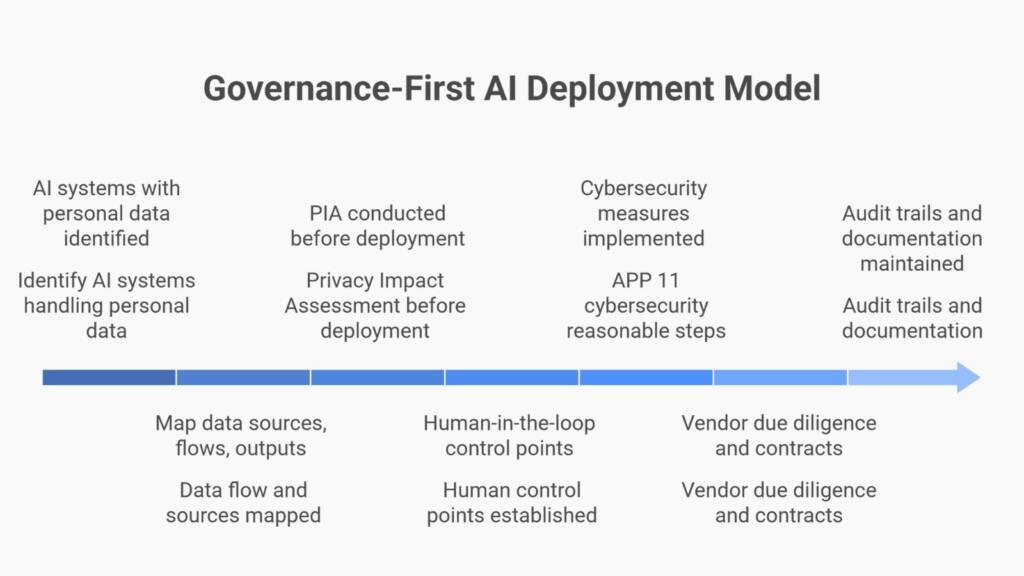
Foundational steps include:
- Identify all AI systems touching personal or health data
- Map data sources, flows, outputs, and retention points
- Clarify decision impact on individuals
- Determine whether AI influences regulated outcomes (safety decisions, eligibility determinations, regulatory submissions)
Essential artefacts for defensible AI deployment:
✓ Privacy Impact Assessment (PIA) completed before deployment
✓ Data classification and provenance documentation
✓ Defined human-in-the-loop (HITL) control points
✓ Retention schedules and deletion procedures
✓ Audit trail demonstrating compliance
The OAIC requires PIAs for high privacy risk activities undertaken by government agencies, and strongly recommends them for any entity deploying AI systems that make decisions with legal or similarly significant effects on individuals
Where Privacy Breaks Down in Real AI Use Cases
Privacy failures in pharmaceutical AI typically occur in four domains.
Clinical trials: Consent forms drafted for traditional trial conduct often fail to cover AI reuse of participant data. Digital twin models generate inferred personal information that participants never provided. Training datasets reflecting historical biases produce AI outputs with subgroup performance disparities.
Pharmacovigilance: Automated case intake pulls personal information from unstructured sources without explicit collection notices. AI narrative generation creates synthetic case descriptions that may inadvertently expose identifiable details. Vendor platforms process cases through cloud infrastructure where data flows remain opaque.
Real-world and secondary data: Dataset linkage creates re-identification risks from supposedly anonymised records. Purpose creep extends data use beyond original collection scope. Cross-border analytics trigger APP 8 obligations that organisations often fail to recognise.
Internal AI tools: Staff using consumer-grade AI tools expose employee and customer data to third-party training datasets. Shadow AI—unapproved tools deployed for convenience—bypasses governance controls entirely. Enterprise versus consumer licensing distinctions determine whether data remains protected or enters vendor training pipelines.
Scenario: A pharmaceutical sponsor deploys an AI tool for literature surveillance in pharmacovigilance. The tool processes published case reports to flag potential signals. However, the vendor’s terms permit customer data to train future model versions. The sponsor’s clinical data—including identifiable patient details from literature cases—enters the vendor’s training dataset without APP 8 cross-border disclosures or data processing agreements. When the OAIC investigates, the sponsor lacks documentation demonstrating awareness of this data flow.
Ethical Expectations and Public Trust in AI-Driven Health Decisions
Australia’s eight AI Ethics Principles—covering human-centred values, fairness, contestability, accountability, and transparency—inform regulatory interpretation even though they remain voluntary. The principles shape how the OAIC assesses whether AI practices meet “fair and reasonable” standards.
For pharmaceutical organisations, ethical alignment carries practical weight. If AI use cannot be explained to a patient, defended to a regulator, and justified to a court, it lacks defensibility. The 2023 Australian Community Attitudes to Privacy Survey found that 96% want conditions in place before AI is used to make decisions affecting them, and 71% want to be told when AI is used.
Public trust erodes when AI operates as a “black box.” Partner confidence depends on demonstrable governance. Reputational risk now compounds regulatory exposure.
Practical Privacy Controls for AI-Enabled Pharma Organisations
Governance controls:
- Maintain an AI register with documented ownership and accountability
- Track automated decision-making for December 2026 disclosure obligations
- Align privacy, quality, and IT policies so AI governance operates consistently
Technical controls:
- Deploy enterprise-grade AI only— consumer tools lack data processing agreements and contractual protections that address Australian Privacy Act obligations.
- Implement data loss prevention to detect sensitive information transmission
- Configure access controls, role-based permissions, and comprehensive audit logging
Operational controls:
- Conduct vendor due diligence including AI-specific questionnaires
- Apply change control to AI model updates and retraining events
- Integrate breach response with NDB scheme notification timelines (30-day assessment, prompt notification)
The Upside: What Organisations Gain by Getting Privacy Right
Privacy governance enables AI scale rather than blocking it. Organisations with documented controls experience faster regulator engagement, fewer remediation cycles, and stronger partner confidence.
Strategic benefits include:
- Regulatory discussions proceed from demonstrated capability rather than gap closure
- AI deployments expand without accumulating compliance debt
- Litigation exposure reduces through documented due diligence
- Partner organisations—sponsors, CROs, vendors—trust your data handling practices
Privacy is not an obstacle to AI adoption. It is the foundation that makes adoption sustainable, defensible, and scalable.
Conclusion: AI Enablement Without Privacy Debt
AI in pharmaceutical operations arrives inevitably. Privacy failure remains optional.
Australian regulators now expect evidence, not intent. The statutory tort, enhanced penalties, and ADM transparency obligations have shifted the compliance landscape. Organisations deploying AI without documented privacy controls accumulate liability that compounds with each additional use case.
Governance-first AI adoption—starting with PIAs, data classification, human oversight, and audit trails—now represents the fastest path forward. Organisations that embed privacy by design today will capture AI’s efficiency benefits while maintaining inspection readiness and patient trust.
The question for pharmaceutical teams centres not on whether to use AI. It centres on whether your AI privacy approach in Australia is defensible when regulators ask for evidence.