


Skip to content Skip to sidebar Skip to footer

Pharmacovigilance Consultant in Australia: Who, What, and How in the AI Age

Introduction

Australia’s pharmaceutical and biotechnology sectors are expanding rapidly, driving increased demand for high-quality drug safety monitoring. Pharmacovigilance (PV)—the science and practice of identifying, assessing, understanding, and preventing adverse effects of medicines—is central to patient safety. This raises critical questions for Australian stakeholders: Who qualifies as a pharmacovigilance consultant, what are their key functions, and how is artificial intelligence (AI) redefining their professional responsibilities?

To navigate this evolving environment, it is essential to understand not only the roles and responsibilities of pharmacovigilance professionals in Australia but also how new technologies, particularly AI, are influencing everyday practice and required skills.

Who Is a Pharmacovigilance Consultant?

In Australia, a pharmacovigilance (PV) consultant is a specialist who provides expert advice on drug safety to pharmaceutical companies, biologics manufacturers, medical device sponsors, and contract research organisations (CROs). PV consultants may operate independently, work with consulting firms, or be integrated within a company’s regulatory or medical affairs teams.

Professionals in this sector commonly possess backgrounds in pharmacy, medicine, nursing, life sciences, or regulatory affairs. In Australia, many PV consultants hold postgraduate qualifications and have direct experience with the Therapeutic Goods Administration (TGA) framework, as well as with international regulatory bodies such as the European Medicines Agency (EMA) and the US Food and Drug Administration (FDA).

Key responsibilities often include:

  • Setting up and maintaining pharmacovigilance systems (including the Pharmacovigilance System Master File, or PSMF)
  • Processing and assessing Individual Case Safety Reports (ICSRs)
  • Preparing Periodic Benefit-Risk Evaluation Reports (PBRERs) and Development Safety Update Reports (DSURs)
  • Signal detection and risk management planning
  • Liaising with the TGA and other regulators on safety-related matters
  • Training staff on adverse event reporting obligations
  • Conducting PV audit and gap assessments

How Is AI Changing Pharmacovigilance in Australia?

Artificial intelligence is no longer on the horizon for pharmacovigilance — it has arrived. Across the globe, AI and machine learning tools are being integrated into PV workflows, and Australian consultants are navigating this shift alongside their international peers.

1. Automated Case Processing

One of the most time-intensive aspects of pharmacovigilance is the processing of ICSRs. AI tools can now assist with intake, triage, narrative writing, and medical coding (using MedDRA terminology). Natural language processing (NLP) algorithms can extract relevant adverse event information from unstructured sources — including social media, electronic health records, and patient-reported outcomes — dramatically expanding the pool of safety data available for analysis.

2. Signal Detection and Risk Assessment

Traditional signal detection relies on disproportionality analysis in large databases such as VigiBase or the FDA Adverse Event Reporting System (FAERS). AI enhances this by processing vast datasets in real time, identifying patterns that might be missed by conventional methods, and prioritising signals for human review. This allows PV consultants to focus their expertise on interpretation and decision-making rather than manual data extraction.

3. Literature Monitoring

Monitoring scientific literature for new safety information is a regulatory requirement — and a resource-intensive one. AI-powered literature screening tools can scan thousands of publications and flag relevant articles for human assessment, reducing the burden on PV teams while improving coverage and consistency.

4. Regulatory Submissions and Report Writing

Generative AI tools are beginning to support the drafting of safety narratives, benefit-risk sections of PBRERs, and even responses to regulatory queries. While human oversight remains essential, these tools can accelerate the writing process and improve consistency across large volumes of documentation.

5. Risk Communication

AI can help tailor risk communication materials for different audiences — patients, healthcare professionals, and regulators — by analysing existing content and suggesting improvements in clarity, readability, and completeness.
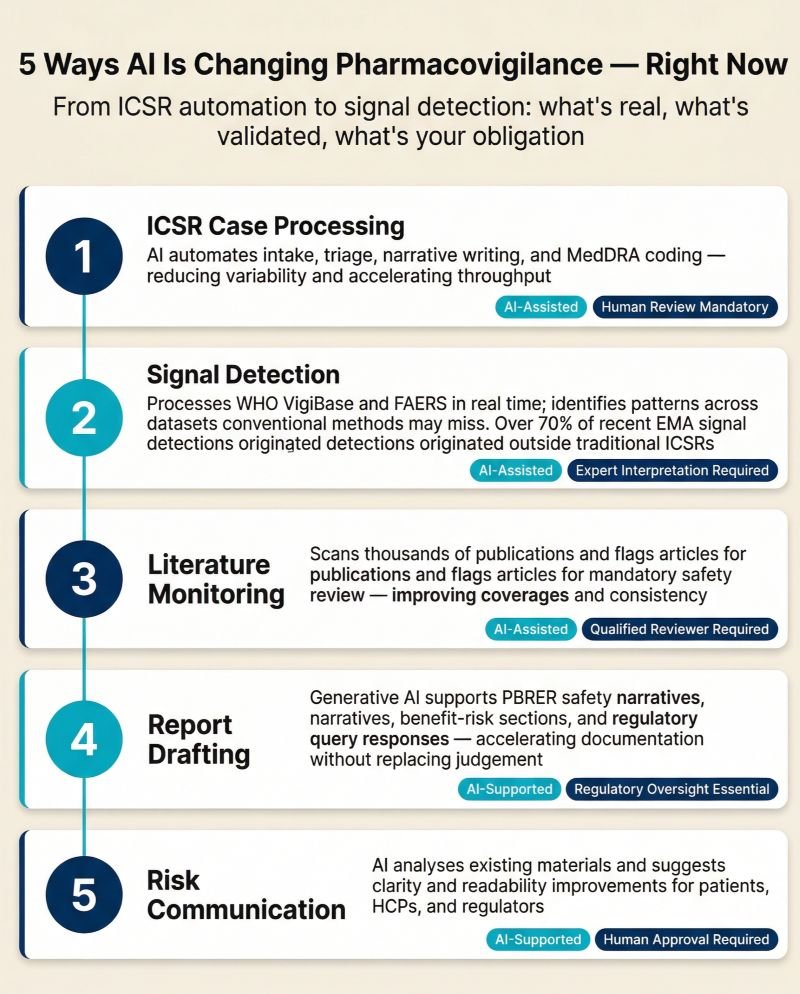
Infographic showing five ways artificial intelligence is transforming pharmacovigilance, including ICSR processing, signal detection, literature monitoring, report drafting, and risk communication, with human oversight requirements highlighted.

The Human Element: What AI Cannot Replace

Despite new AI tools, the role of the pharmacovigilance consultant still relies on skills that technology cannot replicate. Consultants apply regulatory judgement, ethical reasoning, and clinical knowledge to issues that require experience and critical thinking. In practice, consultants use AI to automate routine tasks while retaining responsibility for final review and quality checks, ensuring that both AI and human inputs meet required standards.

In Australia specifically, PV consultants must maintain strong relationships with the TGA and stay up to date with evolving local guidance. The TGA has signalled its interest in AI-assisted safety monitoring, but has also emphasised that sponsors remain fully responsible for the quality and accuracy of their pharmacovigilance activities, regardless of the tools used. This regulatory principle mirrors the approach taken by both the FDA and EMA.

Skills for the AI Age

For pharmacovigilance professionals in Australia looking to remain competitive, developing a hybrid skill set is increasingly important.
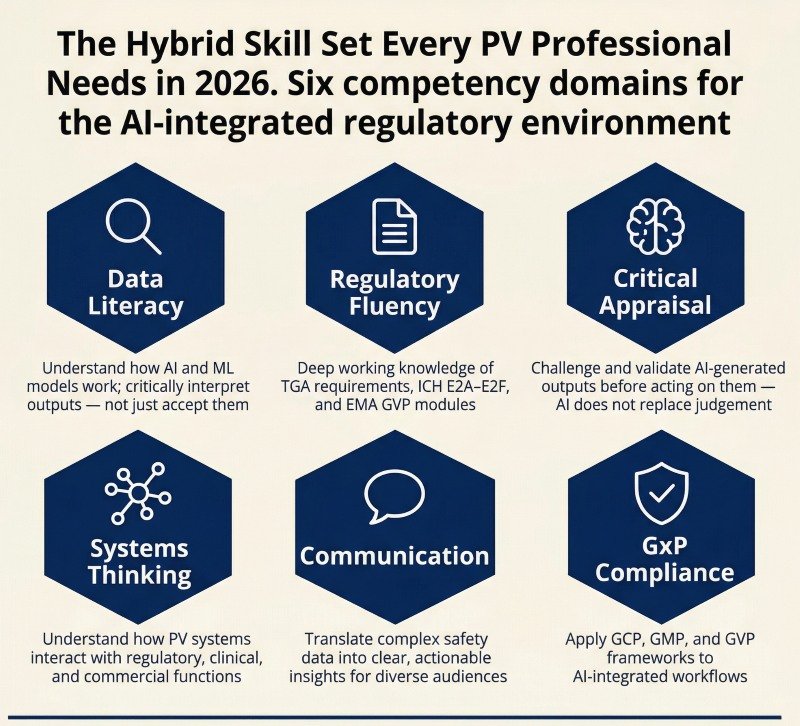

Infographic showing six core competency domains for pharmacovigilance professionals in an AI-integrated regulatory environment, including data literacy, regulatory fluency, critical appraisal, systems thinking, communication, and GxP compliance.

Conclusion

Pharmacovigilance consultants in Australia play a vital role in protecting public health by ensuring that medicines are safe and that adverse events are identified and managed effectively. As AI continues to mature, the most effective PV professionals will be those who can harness these tools intelligently — using them to enhance efficiency and depth of analysis, while applying the human judgement that regulators, patients, and industry partners depend on.

Whether you are a sponsor seeking PV support, a regulator developing AI governance frameworks, or a professional looking to grow in this field, understanding the intersection of pharmacovigilance and AI in the Australian context has never been more important.

Common Questions and Answers

What qualifications do I need to become a pharmacovigilance consultant in Australia?

Most pharmacovigilance consultants hold degrees in pharmacy, medicine, nursing, or life sciences, often supported by postgraduate study in regulatory affairs or clinical research. Practical experience with TGA reporting frameworks, ICSRs, PSMFs, and ICH E2 guidelines is essential. As AI becomes more embedded in PV operations, employers and clients increasingly value data literacy, familiarity with NLP applications, and an understanding of GxP-validated systems.

What is the role of the TGA in pharmacovigilance, and how does it differ from the EMA or FDA?

The TGA is Australia’s national regulator for therapeutic goods under the Therapeutic Goods Act 1989. It requires adverse event reporting for ARTG-registered or listed medicines and oversees compliance through its Pharmacovigilance Inspection Program. While its framework closely aligns with EMA GVP standards, it is adapted for the Australian context, including expectations around the Australian Pharmacovigilance Contact Person. Like the FDA and EMA, the TGA expects sponsors to maintain active pharmacovigilance oversight.

What is an ICSR, and how is AI changing the way they are processed?

An Individual Case Safety Report (ICSR) is a structured record of a suspected adverse drug reaction in a specific patient. It is the core unit of pharmacovigilance reporting. Traditionally, ICSR processing involves intake, MedDRA coding, narrative writing, and regulatory submission. AI and NLP tools now assist with triage, code suggestion, duplicate detection, and draft narratives, improving speed and consistency. Human review and approval remain essential.

What is signal detection in pharmacovigilance, and how does AI improve it?

Signal detection is the process of identifying information that suggests a new or changing association between a medicine and an adverse event. Traditionally, this relies on statistical analysis of safety databases such as VigiBase or FAERS. AI improves signal detection by identifying subtle patterns across broader datasets, including electronic health records and real-world evidence, and by helping prioritise signals for expert assessment.

What is a Pharmacovigilance System Master File (PSMF), and who is responsible for it in Australia?

A PSMF is a detailed description of a sponsor’s pharmacovigilance system, including its structure, personnel, processes, databases, and quality arrangements. In Australia, the TGA does not mandate a PSMF in the same explicit way as the European Union, but maintaining comprehensive PV system documentation is considered best practice and may be reviewed during inspection. Responsibility usually sits with the sponsor, supported by a PV consultant or designated A-PVCP.

How are generative AI tools being used for regulatory submissions in pharmacovigilance?

Generative AI tools are increasingly used to support drafting safety narratives, benefit-risk sections in PBRERs and DSURs, and responses to regulatory questions. They can improve consistency and reduce document preparation time. However, sponsors remain fully responsible for the accuracy, completeness, and compliance of every submission. AI use must sit within a documented, validated, and risk-based framework with clear human oversight.

Can small pharmaceutical companies or CROs in Australia use AI-assisted pharmacovigilance tools?

Yes. Smaller sponsors and CROs are increasingly adopting AI-assisted PV platforms for ICSR intake, literature monitoring, signal dashboards, and MedDRA coding support. Cloud-based tools have made these capabilities more accessible. For many organisations, working with a pharmacovigilance consultant who understands both the regulatory requirements and the practical limits of validated AI systems is an efficient way to strengthen compliance without overbuilding internal capability.

What does the future of pharmacovigilance look like in Australia as AI matures?

Pharmacovigilance in Australia is moving toward greater automation of high-volume, rules-based activities, allowing human experts to focus more on regulatory judgement, benefit-risk evaluation, and stakeholder engagement. The strongest future capability will come from combining deep TGA and ICH knowledge with practical understanding of validated AI tools, data governance, and GxP-compliant implementation. Ongoing professional development will remain essential as expectations continue to evolve.

Pharmacovigilance Services

At GxpVigilance, we help sponsors and MAHs run TGA-ready pharmacovigilance across Australia—built for clarity, control, and inspection readiness.

  • PV system setup & governance (SOPs, SDEAs, oversight)
  • AE intake/triage, case processing & regulatory reporting support
  • Literature monitoring, signal oversight & safety documentation
  • Local PV Contact Person / QPPV / A-PVCP support

Contact GxpVigilance