


Skip to content Skip to sidebar Skip to footer

ICH GCP E6(R3) vs R2: Modernising Trials With Control

Infographic illustrating key steps for transitioning to ICH E6(R3), including CtQ identification, RBQM maturity, sponsor oversight, and inspection-ready training.

ICH GCP E6(R3) vs ICH GCP E6(R2)

Clinical trials have changed. Today’s protocols involve wearable sensors, remote visits, electronic consent, and data flows that E6(R2)—written in 2016—never anticipated. ICH GCP E6(R3) clinical trial modernisation responds to that reality. Adopted in January 2025 and effective in the EU from July 2025, this revision does not lower the bar. Instead, it reframes how sponsors achieve quality.
In practical terms, sponsors, Service Providers, and sites must understand what will actually change and what inspectors will expect. Key takeaway: This article translates ICH GCP E6(R3) clinical trial modernisation into actionable steps so your team knows exactly what to do.

What Actually Changed from ICH GCP E6(R2) to E6(R3)

The shift from R2 to R3 is structural, not superficial. E6(R2) relied on checklists with 13 principles and prescriptive sections. In contrast, E6(R3) consolidates those into 11 high-level principles supported by annexes that allow flexibility while preserving accountability.
 
 
Focus AreaTraditional ApproachModern Approach
Quality Assurance
Retrospective verificationProspective Quality by Design (QbD)
Monitoring
Activity-based schedulesRisk-proportionate oversight
Technology
Implied electronic toleranceExplicitly technology-neutral
Accountability
Distributed across sectionsExplicit sponsor oversight of Service Providers
Documentation
Paper-centric referencesData Governance & metadata-aware
 
The core message of ICH GCP E6(R3) clinical trial modernisation is clear: regulators reduce unnecessary burden on low-risk elements but do not reduce accountability. Consequently, sponsors who interpret “modernisation” as permission to do less will face findings. However, those who focus their effort where risk is highest will find their systems more defensible.

The Structural Shift: Principles and Annexes

E6(R3) introduces a modular architecture designed to remain relevant as trial methodologies evolve. This structure supports GCP R3 implementation across diverse trial types.
  • The Principles document contains 11 consolidated GCP principles in outcome-focused language—describing what sponsors must achieve, not precisely how.
  • Annex 1 provides detailed guidance for traditional interventional trials. As a result, most current sponsors will anchor their processes here.
  • Annex 2, anticipated early 2026, addresses non-traditional designs: pragmatic trials, decentralised trials, and real-world data integration.
Why does this matter for inspections? Inspectors now anchor findings to principles rather than templates. Therefore, they ask how your process demonstrates each principle. Your documentation must show reasoning—particularly where you apply flexibility.
What to document:
  • How each principle is addressed in your QMS.
  • Where you apply proportionate approaches and the supporting rationale.
  • Evidence that flexibility was risk-justified.
 

Quality by Design Is Now Mandatory Thinking

E6(R2) expected quality control. In contrast, E6(R3) expects sponsors to design quality into the trial before it starts. This shift is fundamental to quality-by-design clinical trials.
Under R2, teams detected quality failures through monitoring and corrected them through CAPAs. Under R3, sponsors must identify Critical-to-Quality (CtQ) factors—elements essential to participant safety and data credibility—during protocol development. Accordingly, the focus shifts from detecting errors to preventing them.
CtQ factors are protocol-specific. For example, in an oncology trial, timely tumour assessments might be critical. In a rare disease trial, recruitment and retention might be the CtQ focus.
Practical example: A Phase III oncology sponsor identified CT scans within ±7 days as a CtQ factor. They established a Key Risk Indicator (KRI) to track late-scan percentages, set a Quality Tolerance Limit (QTL) at 10% or less cumulative late scans, and built automated alerts to trigger intervention before the limit is breached. Key takeaways: prospectively design your process, define clear thresholds, and establish planned responses. This illustrates E6(R3) in action.
What inspectors expect:
  • A documented CtQ register that teams maintain throughout the trial.
  • Evidence that protocol design considered quality proactively.
  • Cross-functional input in CtQ identification.

Risk-Based Quality Management Under E6(R3)

E6(R2) introduced risk-based monitoring. E6(R3) expands this to Risk-Based Quality Management (RBQM)—a continuous cycle covering the entire trial lifecycle. This expansion is central to the risk-based quality management requirements of ICH E6.
RBQM under E6(R3) integrates four components:
  1. Risk identification – What could go wrong? Where are the critical data points?
  2. Risk control – What processes or checks mitigate those risks?
  3. Risk communication – How do teams communicate risks across stakeholders?
  4. Risk review – How frequently do teams revisit assessments?
This is not a one-time exercise. Instead, inspectors expect risk assessments that evolve—teams must update them when safety signals emerge, site performance varies, or protocol amendments change the risk profile.
Common inspection gaps:
  • Risk assessments that teams create at study start but never revisit.
  • No documented process for risk escalation.
  • KRIs and QTLs that teams define but do not actively monitor.
Centralised monitoring plays a larger role under R3. Rather than conducting routine on-site source data verification, sponsors now use statistical monitoring and targeted reviews. As a result, on-site visits become risk-triggered rather than calendar-driven.

Technology, Decentralisation, and Data Integrity

E6(R3) explicitly accommodates wearables, eSource, remote visits, EHR integration, and direct-to-patient models. This legitimises decentralized trials, GCP elements that sponsors already practised but lacked a clear regulatory footing for.
However, technology adoption comes with higher—not lower—data integrity expectations. Specifically, the guideline emphasises complete audit trails, metadata preservation, data flow traceability, and proportionate system validation.
Sponsors running trials with wearables or remote patient-reported outcomes must document how they maintain data integrity across the technology chain—including vendor qualification, validation rationale, and data flow maps.
What you must document:
  • Your system validation approach (risk-proportionate).
  • Data flow diagrams for each technology component.
  • Vendor oversight and qualification evidence.
  • ALCOA+ compliance across electronic systems.

Sponsor Oversight Is Sharpened, Not Shared Away

E6(R2) acknowledged that sponsors could delegate trial activities. E6(R3) makes the sponsor oversight ICH E6(R3) expectation explicit: delegation does not transfer accountability.
Sponsors remain responsible for the integrity of delegated work. Therefore, the guideline requires documented oversight plans specifying delegated activities, monitoring methods, escalation pathways, and evidence of review.
This particularly matters for Australian sponsors working with international Service Providers (including CROs). If your Service Provider manages data entry, monitoring, or safety reporting, inspectors will ask for evidence that you maintained active oversight—not that you signed a contract and stepped back.
What inspectors look for:
  • Written oversight plans (not just service agreements).
  • Vendor performance review records.
  • Decision logs showing sponsor engagement on quality issues.
  • Clear delegation and responsibility matrices.

Where Do You Start? A Practical Transition Pathway

The transition to E6(R3) does not require rebuilding every system simultaneously. Instead, start with a structured assessment.
  • Step 1: Map your current R2-based processes against the 11 E6(R3) principles. Then identify gaps.
  • Step 2: Review your CtQ approach. Do you identify critical factors prospectively with cross-functional input?
  • Step 3: Assess your RBQM maturity. Are your risk assessments living documents with defined escalation?
  • Step 4: Evaluate your oversight mechanisms. Can you demonstrate active sponsor engagement beyond contract signature?
  • Step 5: Prioritise high-risk trials for early transition. New studies starting in 2026 should follow E6(R3) principles from the outset.
  • Step 6: Train your teams on principles, not just SOPs. Inspectors will ask staff to explain rationale, not recite procedures.

E6(R3) Readiness Checklist

Use this checklist to assess your current state and prioritise transition:
  • You document and maintain a CtQ register for active studies.
  • Your team performs risk assessments at study start and reviews them throughout the lifecycle.
  • Your RBQM plan aligns with actual trial risks (not a generic template).
  • You document oversight plans for CROs and vendors.
  • You map data integrity controls (ALCOA+ across electronic systems.
  • You document the rationale for the technology validation (proportionate approach).
  • You maintain clear delegation and responsibility matrices.
  • Your inspection-ready evidence repositories are accessible.
  • Staff complete training on E6(R3) principles and rationale.
  • Management reviews quality signals and escalation evidence.
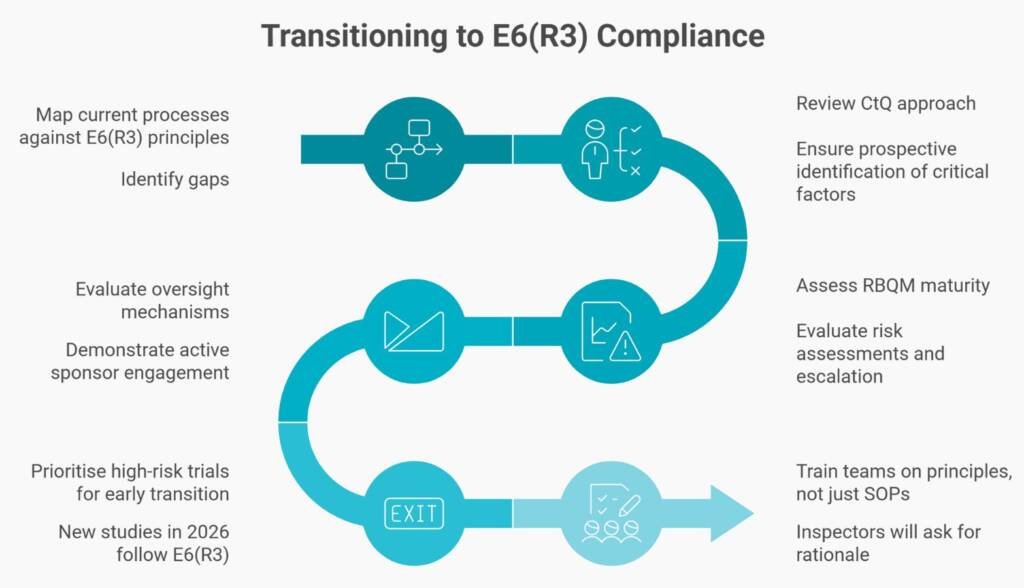
Infographic illustrating key steps for transitioning to ICH E6(R3), including CtQ identification, RBQM maturity, sponsor oversight, and inspection-ready training.

Ethics, Participants, and Transparency

E6(R3) reinforces participant-centric language. Informed consent must ensure participants understand not just trial procedures but how teams will collect, use, and protect their data—particularly with digital tools.
Additionally, the guideline strengthens expectations for trial registration and results transparency. For vulnerable populations, sponsors must provide additional safeguards and documented justifications. Patient safety remains the anchor. Every quality system, risk assessment, and oversight mechanism traces back to protecting participants and ensuring data credibility.

What E6(R3) Is Not

To avoid misinterpretation, be clear about what E6(R3) does not permit:
  • It is not a relaxation of GCP standards.
  • It is not permission for unchecked automation without human oversight.
  • It is not a reason to reduce documentation or skip validation.
  • It is not an excuse to remove human judgment from safety-critical decisions.
Modernisation means smarter resource application—not fewer controls.

Conclusion: Modernisation With Control

ICH GCP E6(R3) clinical trial modernisation rewards sponsors and sites who design quality into trials from the start, focus oversight where risk is highest, and maintain clear accountability when delegating.
The transition timeline varies by region—EMA compliance is already required, and the TGA has officially adopted the guideline (effective 13 January 2026) with enforcement following the 12-month transition period in 2027. Regardless of jurisdiction, inspectors worldwide will increasingly reference E6(R3) principles.
Those who treat this as an administrative burden will struggle. In contrast, those who treat it as an opportunity to build more defensible, patient-focused trials will find inspections less painful and quality genuinely improved.
The practical next step: Conduct an honest gap assessment against E6(R3) principles. Identify where your processes align, where gaps exist, and what actions will close those gaps before your next inspection.


Common Questions and Answers

When does ICH E6(R3) become mandatory in Australia?

The TGA expects to adopt ICH E6(R3) in early 2026 with a 12-month transition period. Full enforcement is anticipated from February 2027. During the transition, sponsors may comply with either E6(R2) or E6(R3), but new studies should be designed under R3 principles.

What is the main difference between E6(R2) and E6(R3)?

E6(R3) shifts from checklist compliance to principle-driven quality management. It emphasises prospective quality by design, risk-proportionate oversight, and explicit sponsor accountability—rather than prescriptive procedures applied uniformly regardless of risk.

What are Critical-to-Quality (CtQ) factors?

CtQ factors are elements essential to trial success, participant safety, and data credibility. They are identified during protocol development and used to focus quality efforts on what matters most. Examples include timely safety reporting, accurate endpoint measurements, or protocol adherence at high-risk sites.

Does E6(R3) reduce monitoring requirements?

E6(R3) enables risk-proportionate monitoring, not reduced monitoring. Low-risk elements may receive less intensive oversight, but high-risk elements require more focused attention. Centralised statistical monitoring often replaces routine 100% source data verification.

How does E6(R3) address decentralised clinical trials?

E6(R3) is technology-neutral, explicitly accommodating wearables, eSource, remote visits, and electronic consent. Annex 2 (expected late 2025) will provide detailed DCT guidance. Data integrity expectations increase with technology complexity—audit trails, validation, and oversight must be documented.

What sponsor oversight evidence will inspectors expect?

Inspectors will look for written oversight plans, vendor performance reviews, decision logs showing sponsor engagement, and clear responsibility matrices. The contract alone is insufficient—active, documented oversight throughout the trial is required.

How should we prepare staff for E6(R3) inspections?

Train teams on the 11 E6(R3) principles and the rationale behind your processes. Staff should be able to explain why procedures exist, how risks are managed, and what evidence supports compliance—not just recite SOP steps. Inspectors assess understanding, not memorisation.

Disclaimer

This article is provided for educational and informational purposes only. It is intended to support general understanding of regulatory concepts and good practice and does not constitute legal, regulatory, or professional advice.

Regulatory requirements, inspection expectations, and system obligations may vary based on jurisdiction, study design, technology, and organisational context. As such, the information presented here should not be relied upon as a substitute for project-specific assessment, validation, or regulatory decision-making.

For guidance tailored to your organisation, systems, or clinical programme, we recommend speaking directly with us or engaging another suitably qualified subject matter expert (SME) to assess your specific needs and risk profile.