
The GCP auditor in Australia is pivotal yet often misunderstood. This role demands more than procedural checks; it is fundamental in safeguarding clinical trial integrity, balancing evolving regulations, patient safety, and productive collaboration.
GCP auditors are the operational conscience of Australia’s clinical research, directly protecting patient safety and research quality. Auditors who excel proactively find vulnerabilities, support compliance, and ensure timely patient access to treatments. When they fall short, patients are at risk, and sponsors face costly delays.
Australia’s clinical trial sector has grown, attracting international sponsors with competitive R&D tax incentives and a reputation for high-quality data. This growth has increased demand for GCP auditors who know local TGA requirements and the international frameworks sponsors require. The profession sits at a critical intersection: regulatory compliance, patient protection, and commercial viability all depend on auditors’ performance.
This article examines what makes a GCP auditor in Australia effective—the qualifications, regulatory knowledge, experience, personality traits, and continuous learning that set competent auditors apart.
What Makes GCP Auditing Different
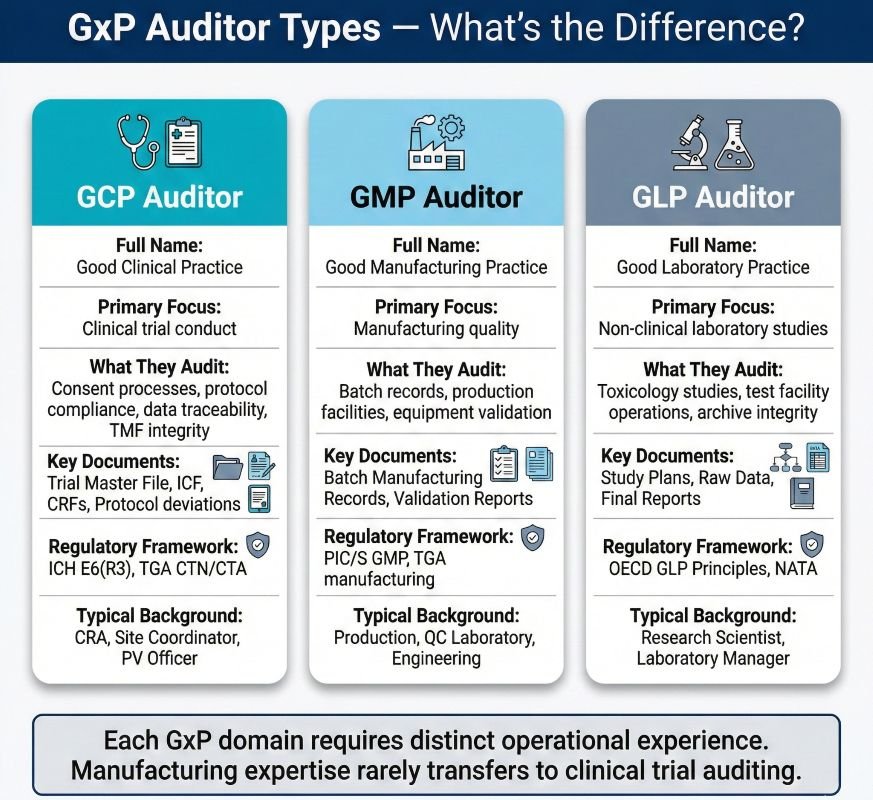
GCP (Good Clinical Practice) auditing differs from other GxP (Good Practice) disciplines. GMP (Good Manufacturing Practice) auditors focus on manufacturing controls. GLP (Good Laboratory Practice) auditors assess non-clinical laboratory studies. The GCP auditor evaluates the conduct of clinical trials: informed consent processes, protocol adherence, investigational product management, and data integrity across complex multi-site operations.
The scope covers the full clinical supply chain. Sponsors maintain oversight. CROs carry out monitoring. Investigator sites recruit and treat participants. Hospital pharmacies dispense trial medications. Central laboratories analyse samples. Each element demands different technical knowledge and assessment.
Key distinction: Process auditing at this level needs formal training and recognised qualifications. A GCP auditor must interpret regulations, not apply them mechanically. ICH E6(R3) took effect in Australia in January 2026. Sponsors now must use risk-based quality management. Auditors assess if organisations have identified Critical-to-Quality factors and applied proportionate controls, not just if procedures exist.
Experience, Capability, and Professional Maturity
GCP auditors rarely begin their careers in auditing. Most start in operational roles—such as Clinical Research Associate, pharmacovigilance officer, hospital pharmacist, or laboratory scientist—then move into quality assurance and later to auditing. This operational background gives them the context needed to turn audit findings into actionable intelligence.
Typical experience requirements:
- Entry-level QA roles: 2-3 years of operational experience
- Independent auditor positions: 5+ years in quality assurance, including 3+ years conducting audits
- Senior lead auditor roles: 10+ years combined GxP experience, 5+ years leading audit programmes
Career progression typically unfolds across three phases:
- Early-stage (0-3 years): Supporting internal audits, managing CAPA documentation, and observing senior auditors during site visits.
- Mid-career (3-7 years): Owning full audit cycles, specialising in specific areas (site audits, vendor qualification, GVP).
- Senior progression (7+ years): Shaping annual audit programmes, integrating findings with clinical operations, co-owning inspection readiness
The Australian market accepts several qualification paths. ISO 9001 Lead Auditor credentials give a basic understanding of audit methods. Specialised GxP training by organisations such as SeerPharma and ARCS builds pharmaceutical skills. More often, auditors get ISO 42001 certification to check AI systems as automated tools enter GxP work.
- Curiosity: The compulsion to keep asking “why?” until root causes emerge
- Resilience: Maintaining objectivity despite pushback or organisational pressure. Independence: Drawing conclusions solely from objective evidence, not influenced by relationships or politics.
- Ethical judgement: Reporting critical findings, even when doing so may create discomfort.
- Diplomatic directness: Providing constructive, clear feedback on difficult issues without diluting key points.
ISO 19011 names thirteen key behavioural competencies for auditors. These include being ethical, open-minded, observant, perceptive, versatile, tenacious, and decisive.
The GCP auditor in Australia must balance these: be firm enough to classify real risks, yet flexible enough to know there are many ways to meet regulatory requirements.
Common misconception: Effective auditors are not adversarial “gotcha” inspectors.
The modern approach emphasises partnership. Auditors identify systemic vulnerabilities and guide sustainable improvement. Their goal is not simply documenting failures. Organisations that treat auditors as enemies tend to have poor disclosure. Those treating them as trusted advisors benefit from genuine quality improvement.
Continuous Learning in a Changing Landscape
The regulatory environment evolves continuously. In 2024 alone, the FDA published 42 new or revised guidance documents relevant to pharmaceutical operations. TGA regularly updates its expectations, and ICH E6(R3) introduced substantial changes to risk-based quality management requirements. An auditor who stops learning quickly becomes outdated.
Regulatory intelligence forms the foundation of professional currency. Experienced auditors subscribe to official channels, including TGA guidance updates, FDA warning letters, EMA questions and answers, and ICH guideline revisions. Many use commercial regulatory intelligence services or AI-powered monitoring tools that flag relevant changes based on their professional interests. This systematic approach prevents auditors from being surprised by requirements their auditees have already implemented.
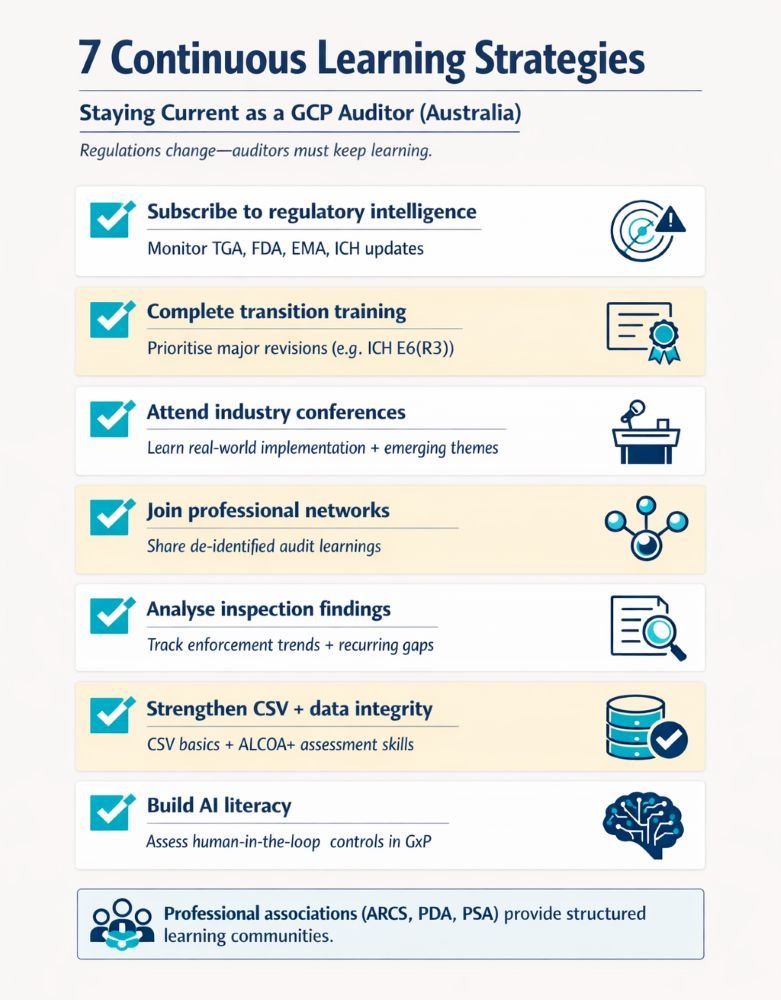
Effective continuous learning strategies:
- Subscribe to regulatory intelligence services covering TGA, FDA, EMA, and ICH updates.
- Complete transition training for major guideline revisions (currently ICH E6(R3))
- Attend industry conferences to learn about practical implementation case studies.
- Participate in professional networks sharing de-identified audit experiences.
- Analyse regulatory inspection findings to identify emerging themes
- Develop competency in Computerised System Validation and data integrity assessment.
- Build AI literacy to evaluate automated tools entering GxP operations.
The AI dimension now requires special attention. Sponsors use machine learning for patient recruitment, adverse event detection, and adaptive trial design. Auditors must verify that these systems are properly validated. Traditional methods fall short for models that learn from new data. Auditors need new frameworks for evaluating transparency, training data, and oversight controls.
Forward-thinking auditors use AI tools too. Central monitoring platforms analyse clinical data to find outlier sites or suspicious patterns before audits. Natural language processing tools scan thousands of documents to flag missing signatures or inconsistent dates. There is professional debate about how much AI is too much; each auditor must decide how to avoid over-reliance on these tools.
Conclusion: Why Great GCP Auditors Matter
The GCP auditor in Australia serves a function that extends beyond compliance verification. Effective auditors protect patients by identifying trial conduct vulnerabilities before those vulnerabilities cause harm. They protect sponsors by ensuring inspection readiness before the TGA arrives unannounced. They strengthen Australia’s clinical research reputation by maintaining the standards that attract international trial investment.
The profession requires significant investment: years in operational roles before switching to audits, ongoing qualification maintenance, and ongoing regulatory intelligence gathering. Increasingly, auditors also need technical skills in AI governance. Organisations that understand this—offering resources, professional development, and real partnership—create quality systems that pass any regulatory test.
For those considering this career pathway, the threshold question is straightforward: Can you maintain curiosity, independence, and ethical commitment over a career that will frequently place you in conflict with operational.
If so, a career in this field provides an opportunity to contribute to patient safety while developing expertise applicable across pharmaceutical, biotechnology, and clinical research sectors.