
What is the Australian-Specific Annexure (ASA)?
The Australian-Specific Annexure (ASA) is a mandatory regulatory document that adapts a global or European Union Risk Management Plan (EU RMP) to the Australian health context. Since the TGA adopts the EU RMP format, the ASA acts as a bridge, ensuring risk minimisation strategies designed for Europe fit Australia’s healthcare system, demographics, and medical practices.
Why is it indispensable?
- Local Customisation: It tailors safety concerns to the Australian population (e.g., different indigenous health factors or prescribing practices).
- Regulatory Alignment: It addresses specific TGA requirements that may differ from the EMA (European Medicines Agency).
- Safety Assurance: It defines how risks will be monitored (pharmacovigilance) and mitigated specifically within Australia.
| Requirement | Details |
|---|---|
| Core Document | EU Risk Management Plan (EU RMP) + Australian-Specific Annexure (ASA) |
| Regulator | Therapeutic Goods Administration (TGA) |
| Mandatory For | New Chemical Entities, Vaccines, Class 3/4 Biologicals |
| Submission Format | eCTD or NeeS (Module 1.8.2) |
| Key Guideline | EMA GVP Module V & TGA RMP Guidelines (Ver 3.3+) |
What is the Australian-Specific Annexure (ASA)?
The Australian-Specific Annexure (ASA) is a mandatory regulatory document that adapts a global or European Union Risk Management Plan (EU RMP) to the Australian health context. Since the TGA adopts the EU RMP format, the ASA acts as a bridge, ensuring risk minimisation strategies designed for Europe fit Australia’s healthcare system, demographics, and medical practices.
Why is it indispensable?
- Local Customisation: It tailors safety concerns to the Australian population (e.g., different indigenous health factors or prescribing practices).
- Regulatory Alignment: It addresses specific TGA requirements that may differ from the EMA (European Medicines Agency).
- Safety Assurance: It defines how risks will be monitored (pharmacovigilance) and mitigated specifically within Australia.
When is an RMP and ASA Required?
Submitting an RMP is required for many products. The TGA classifies requirements as Mandatory or Situational.
1. Mandatory Submissions
You must submit an RMP and ASA for:
- New Chemical Entities: All new active pharmaceutical ingredients.
- Vaccines: All prophylactic vaccines.
- Biologicals: Class 3 and 4 biologicals (under the TGA biological framework).
- Biosimilars: Unless the reference product has no additional risk minimisation activities.
2. Situational Requirements
An RMP is often required if your application involves:
- Significant Population Changes: E.g., extending use to paediatrics.
- New Dosage/Routes: A new route of administration that carries a higher risk (e.g., oral to intravenous).
- Manufacturing Changes: Specifically for biotechnologically derived products.
- Generic Medicines: Generally not required, unless the reference product has “Additional Risk Minimisation Activities” (e.g., Thalidomide, Isotretinoin).
Anatomy of a Compliant ASA
A robust ASA must integrate with the EU RMP. It generally consists of four sections designed to localize the global plan.
1. Introduction | Registration history, ARTG numbers, and a summary of the Australian epidemiological context. |
2. Pharmacovigilance Plan | Details on the Australian pharmacovigilance (PV) system, responsible persons, and any Australia-specific safety studies. |
3. Risk Minimisation Plan | The core strategy. It compares EU vs. Australian activities and details specific interventions (e.g., educational materials). |
4. Summary | A high-level overview of all ongoing safety concerns and the plan to address them. |
Pro Tip: The ASA must explicitly justify any difference between the EU RMP and the Australian plan. If the EU requires a patient registry but Australia does not, you must provide a scientific justification for this.
Risk Minimisation Strategies: Selecting the Right Tools
The TGA categorises risk management into two tiers. Your ASA must clearly define which activities fall into which tier.
Routine Risk Minimisation
Standard activities applicable to all medicines:
- Product Information (PI): The official summary of product characteristics.
- Consumer Medicine Information (CMI): Patient-friendly leaflets.
- Labelling: Warning statements on packaging.
Additional Risk Minimisation
Required for high-risk products. Examples include:
- Educational Programs: Training modules for doctors or pharmacists.
- Controlled Access Schemes: E.g., prescribing is restricted to certified specialists.
- Dear Healthcare Professional Letters (DHPL): Direct communication about emerging risks.
- Pregnancy Prevention Programs: Strict testing protocols for teratogenic drugs.
Monitoring Effectiveness: Closing the Loop
Implementing a plan is not enough; you must prove it works. The TGA expects your ASA to detail how you will measure success using three types of indicators:
- Process Indicators: “Did we do it?” (e.g., % of physicians who received the educational letter).
- Impact Indicators: “Did it change behaviour?” (e.g., surveys showing physicians now check liver function before prescribing).
- Outcome Indicators: “Did it improve safety?” (e.g., reduction in the rate of reported adverse events).
Challenges & Solutions in ASA Development
Navigating TGA requirements can be complex. Here is how experts handle common hurdles:
Challenge: Lack of Local Data.
- Solution: Extrapolate from similar overseas populations and clearly note assumptions and limitations in the Safety Specification section.
Challenge: Tight Timelines.
- Solution: Start drafting the ASA before the final EU RMP is locked. Use a modular approach to update sections as data becomes available.
Challenge: Regulatory Pushback.
- Solution: Anticipate TGA questions. Ensure your Justification for Differences section is scientifically rigorous, as weak justifications are a primary cause of delays.
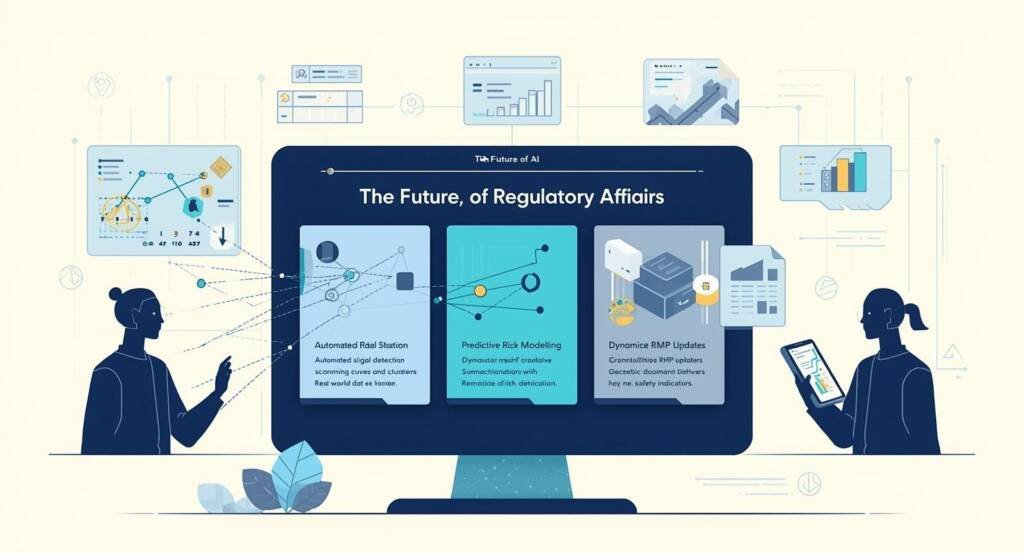
The Future: AI in Regulatory Affairs
Artificial Intelligence is transforming how RMPs are maintained. Expect to see:
- Automated Signal Detection: AI algorithms scanning real-world data (electronic health records) to identify safety signals faster than manual review.
- Predictive Risk Modelling: Using machine learning to predict which patient subpopulations are at highest risk, allowing for hyper-targeted risk minimisation.
- “Living” RMPs: Dynamic documents that update in real-time as new safety data flows into the system.
Frequently Asked Questions (FAQ)
Q: Can I use the EU RMP without an ASA?
A: No. The TGA requires an Australian-specific Annexure for all submissions that utilise an EU RMP to ensure local applicability.
A: No. The TGA requires an Australian-specific Annexure for all submissions that utilise an EU RMP to ensure local applicability.
Q: How often must the ASA be updated?
A: The ASA must be updated whenever the EU RMP is updated, when a “Significant Safety Issue” arises, or upon TGA request.
A: The ASA must be updated whenever the EU RMP is updated, when a “Significant Safety Issue” arises, or upon TGA request.
Q: Who evaluates the RMP in Australia?
A: The RMP is evaluated by the TGA’s RMP Evaluation Section, often with advice from the Advisory Committee on Medicines (ACM).
A: The RMP is evaluated by the TGA’s RMP Evaluation Section, often with advice from the Advisory Committee on Medicines (ACM).
References
Guideline on good pharmacovigilance practices (GVP) Module XVI – Risk minimisation measures: selection of tools and effectiveness indicators (Rev 2)
European Medicines Agency (EMA)Guideline on good pharmacovigilance practices (GVP) Module V – Risk management systems (Rev 2)
Risk management plans – Australian-Specific Annex (ASA) template and resources.
Therapeutic Goods Administration (TGA)